TL;DR
The E36 fuel system is simple: an electric pump in the tank, an inline filter, a fuel rail feeding the injectors, and a pressure regulator that sends excess fuel back to the tank. When something goes wrong, diagnosis starts with a fuel pressure gauge: system pressure, the regulator’s response to vacuum, and residual pressure after shut-off tell you most of what you need to know.
Where everything is
| Component | Location |
|---|---|
| Fuel tank | Under the rear seat |
| Fuel pump | In the tank, mounted together with the right-hand fuel level sender; reached through the right access cover under the rear seat cushion |
| Fuel level senders | One each side of the tank, wired in series; the left side has no pump |
| Fuel filter, early six-cylinder cars | On the front left engine mount, in the engine compartment |
| Fuel filter, later cars | Under the centre of the car, roughly below the driver’s seat, behind a protective cover |
| Fuel pressure regulator, M50 | On the fuel rail, with a vacuum hose to the intake manifold |
| Fuel pressure regulator, later cars (M52) | Under the car, at the fuel filter |
| Fuel pump relay | In the power distribution box; a four-pin relay with a 1.5 mm² red wire at terminal 30 |
Not sure which version your car has? Look at the fuel rail: if there’s no regulator on it, yours is the later type under the car.
Fuel pressure specifications (Bentley)
| Engine | System pressure |
|---|---|
| M50 / S50US | 3.0 ± 0.2 bar |
| M52 / S52US | 3.5 ± 0.2 bar |
- At idle (vacuum acting on the regulator), pressure should be 0.4–0.7 bar lower than the table.
- Residual pressure: 20 minutes after the pump stops, pressure should not have dropped more than 0.5 bar from system pressure.
Use a gauge reading 0–5 bar. On the six-cylinder, remove the top engine cover to reach the fuel rail. OBD2 six-cylinder engines use locking fuel-line fittings that need BMW tool 16 1 050 to release.
Testing
Running the pump without the engine
To run the pump for tests, remove the fuel pump relay and bridge relay sockets 30 and 87 with a fused jumper wire. Remove the jumper when you’re done.
Keep at least 5 litres of fuel in the tank for any pump test: the pump is damaged if it runs dry.
System pressure
- Relieve the pressure (wrap a shop towel around a fuel line fitting and loosen it slowly), then connect the gauge.
- Run the pump through the relay bypass and read the pressure. Compare with the table.
Regulator response
- Refit the relay, start the engine and let it idle. Pressure should be 0.4–0.7 bar below spec.
- Pull the vacuum hose off the regulator: pressure should rise.
- Refit it: pressure should drop again.
If pressure doesn’t respond to the vacuum hose, check the hose; if the hose is good, the regulator is faulty.
Residual pressure
- With the gauge connected, run the pump for about one minute through the relay bypass, then switch it off.
- Read the gauge after 20 minutes. It should not have dropped more than 0.5 bar.
If it drops further, look for leaks at lines and unions first. A leaking injector or a faulty check valve in the pump can also cause it. Bentley’s next step is to repeat the test with the return line at the rail pinched off before the pump is switched off. If the pressure then holds, Bentley points to the pump check valve. The check valve is not sold separately.
Injectors
The injectors are switched by the DME. Test them with a digital multimeter or an LED injector tester only: an analog meter or a bulb test light can damage the engine control module.
- No injector pulse: check for battery voltage at the injector connector with the ignition on. If it is missing, check the main relay output and the wiring.
- Voltage present but no pulse from the DME: check the wiring between the DME and the injectors before suspecting the DME itself.
Injectors come out together with the fuel rail: remove the rail, then unclip the injectors. Refit with new O-rings, lightly lubricated.
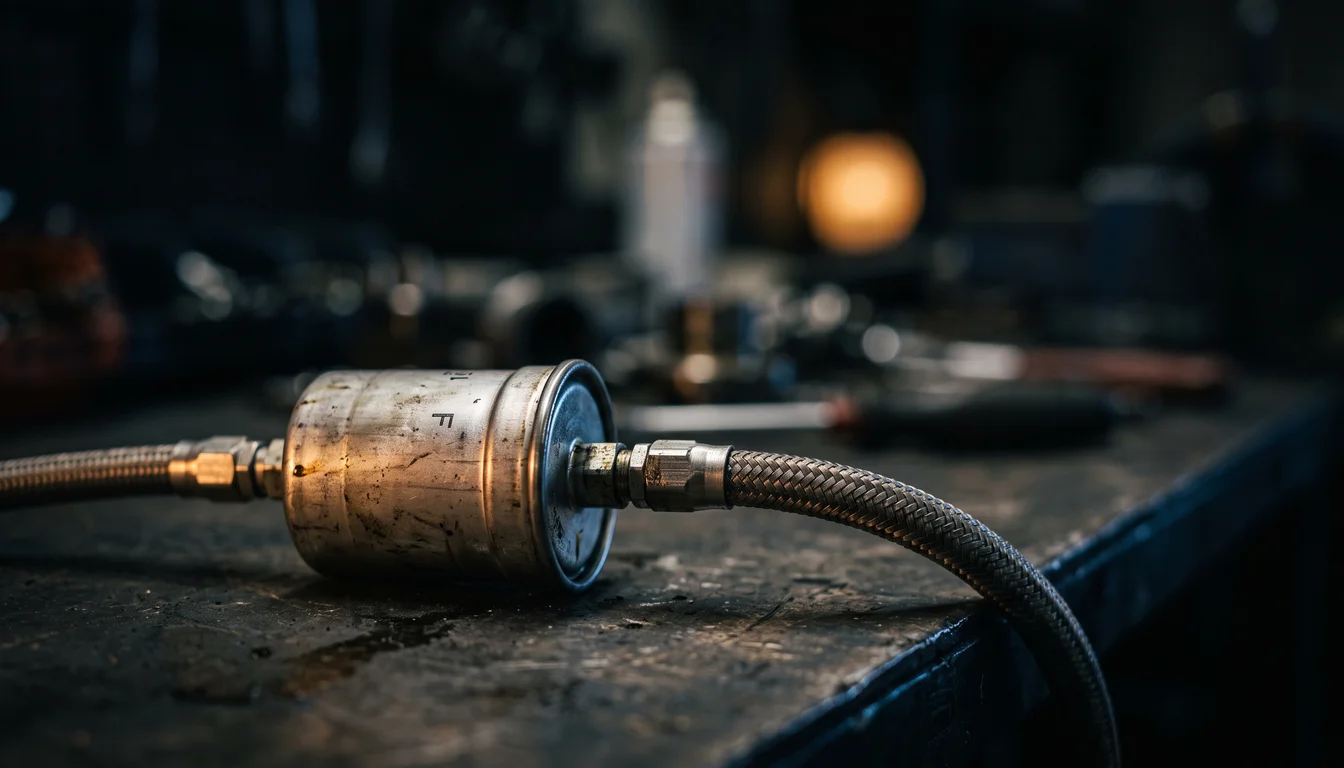
Fuel filter
On an old car with no service history, replace the filter: it’s a routine item in BMW’s service schedule and cheap insurance.
- Disconnect the battery negative cable.
- Clamp the filter’s inlet and outlet hoses to limit spillage.
- Clean thoroughly around the connections before opening them.
- Loosen the centre clamping bracket and the hose clamps at each end, and remove the filter.
- Before fitting the new filter, drain the old one from its inlet side into a container and inspect the fuel. Rust, water or dirt means the tank needs attention.
- Fit the new filter with its flow arrow in the right direction, using new hose clamps.
Fuel will come out when the filter is removed: no smoking or heaters nearby, and keep a fire extinguisher at hand.
Fuel pump replacement
- Run the tank down if you can, and disconnect the battery.
- Remove the rear seat cushion and fold back the insulation to expose the access covers.
- Remove the right access cover, disconnect the pump and sender connectors and the fuel lines, and unscrew the threaded collar.
- Lift out the pump with the sender. Clean around the opening first so no dirt drops into the tank.
- Refit with a new sealing ring, then check for leaks with the engine running before refitting the access cover.
Symptom chart
| Symptom | Likely cause | First check |
|---|---|---|
| No start, pump silent while cranking | Fuel pump relay, fuse, pump, or no crankshaft signal to the DME | Bridge relay 30–87 (fused) and listen; check voltage at the pump. On the M50’s Bosch DMEs the pump runs only while cranking or running, so silence with the ignition merely on is normal |
| Hard start when hot | Pressure leaking away after shut-off | Residual pressure test |
| Hesitation or leanness at high load | Weak pump or blocked filter | System pressure under load; replace the filter |
| Pressure doesn’t change with the vacuum hose | Regulator or its vacuum hose | Regulator response test |
| Pressure doesn’t hold | Leaking line, injector or pump check valve | Residual pressure test, with and without the return line pinched |
| Rough running on one cylinder | Injector or its wiring | Injector voltage and pulse checks |