TL;DR
| What: | Removing E36 front seats, repairing the frame and recliner, rebuilding the foam and fitting new covers. |
| Why: | Collapsed bolsters, torn covers and worn recliners are normal on a seat that’s 25-plus years old. |
| Safety: | The front seat belt locks have tensioners: Bentley says to deactivate them before removing the seat and reactivate them afterwards. |
| Difficulty: | 3/5. Removal is easy; upholstery takes patience. |
Common E36 seat problems
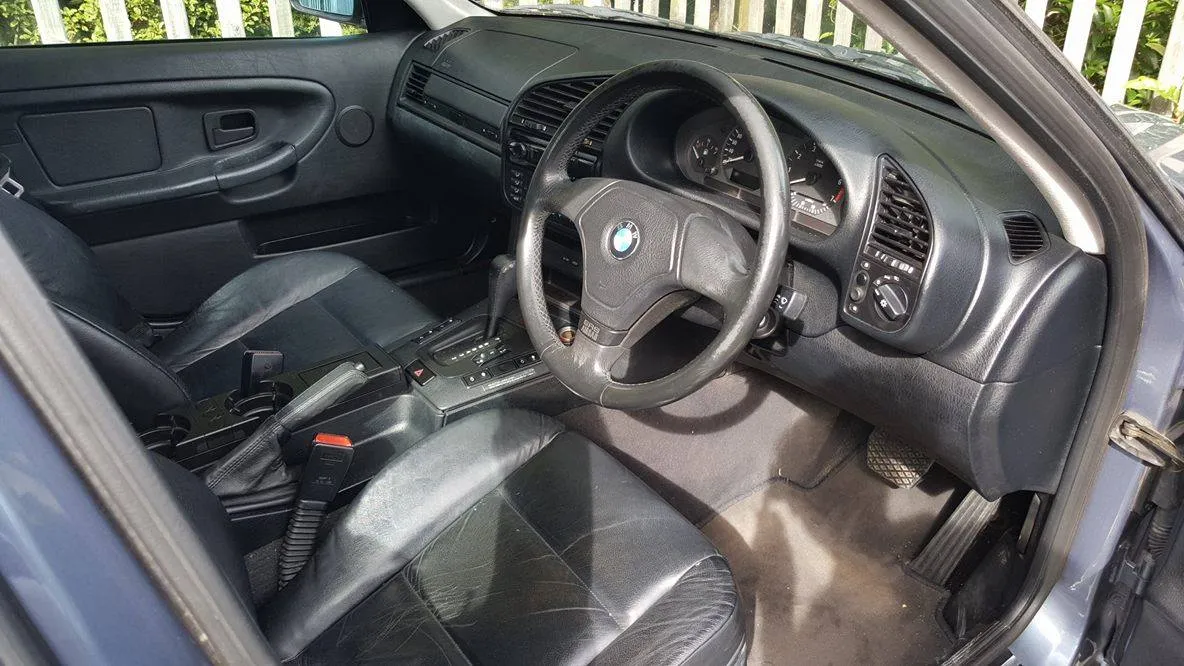
- Collapsed outer bolster on the driver’s seat, from years of getting in and out
- Worn or torn covers, especially on the bolster and the seat base edge
- Sagging cushion from tired foam or broken support springs underneath
- Loose or worn recliner mechanism, so the backrest moves or leans
- Torn or missing plastic trim around the seat base and hinges
Removing a front seat (Bentley)
- Move the seat fully forward and as high as possible; remove the two bolts at the rear of the rails.
- Move the seat fully back, still raised.
- Disconnect the negative battery cable.
- Deactivate the front seat belt lock tensioners (Bentley 720 Seat Belts). Through the 1996 model year they’re mechanical spring tensioners; 1997-on cars have pyrotechnic (explosive) ones.
- Remove the plastic caps and the front mounting nuts.
- Two-door cars: unhook the belt from the guide on the seatback. Four-door cars: unbolt the belt from the seat frame.
- Tilt the seat back and unplug the electrical connectors.
- Lift the seat out. A blanket over the door sill prevents scratches.
Recliner and frame
- Strip the seat to the frame and check the recliner mechanisms, the backrest hinges and the frame welds for cracks, wear and broken parts.
- Worn recliner parts can be replaced with BMW parts (look them up by VIN on RealOEM, Seats) or with a good used seat frame. Aftermarket reinforcement kits are also sold.
- Clean surface rust off the frame and paint it before the foam goes back on.
- Check the support springs or straps under the cushion: broken ones make even new foam sag.
Rebuilding the foam
- Local repair: cut out the collapsed area of the bolster, bond in shaped high-density upholstery foam with a suitable foam adhesive, then shape and smooth it. A thin layer of scrim foam over the top hides the joint.
- New foam: where the whole cushion has collapsed, replace it. Check availability by part number on RealOEM for your exact seat (standard, sport, cloth or leather), as these differ.
Fitting new covers
- Warm the covers so they stretch more easily.
- Secure the centre first: the listing rods in the cover attach to wires in the foam or frame with new hog rings.
- Pull the edges down evenly and fix them to the frame. Work from side to side to keep the seams straight.
- Steam or gentle heat removes the last creases.
Refitting the seat (Bentley)
- Secure the seat wiring with ties so it can’t fray.
- Reactivate the front seat belt locks.
- Start all four mounting fasteners, then tighten them in this order: inner front, outer front, inner rear, outer rear.
- Front seat to floor: 55 Nm.
See also: door panel restoration · sound deadening