TL;DR
| M50B25 (non-VANOS) | M50B25TU (VANOS) | M52B25 / M52B28 | |
|---|---|---|---|
| Built | 1990–1992 (E36: up to 8/1992) | 1992–1996 | 1995–2000 |
| Power | 192 PS | 192 PS | 170 PS / 193 PS |
| Torque | 245 Nm @ 4,700 rpm | 250 Nm @ 4,200 rpm | 245 Nm / 280 Nm @ 3,950 rpm |
| Block | Cast iron | Cast iron | Aluminium in most markets (Nikasil, later iron sleeves); cast iron in original US/Canadian cars |
| VANOS | None | Single (intake, up to 12.5°) | Single (intake) |
| Engine management (Bentley) | Bosch DME M3.1 (OBD1) | Bosch DME M3.3.1 (OBD1) | Siemens MS41.1 (OBD2, 1996 on) |
| Knock sensors | None | Two | Two |
| Connecting rods | 135 mm | 140 mm | 135 mm |
| Valve stems | 7 mm | 6 mm | 6 mm |
| Valve springs | Double | Single | Single |
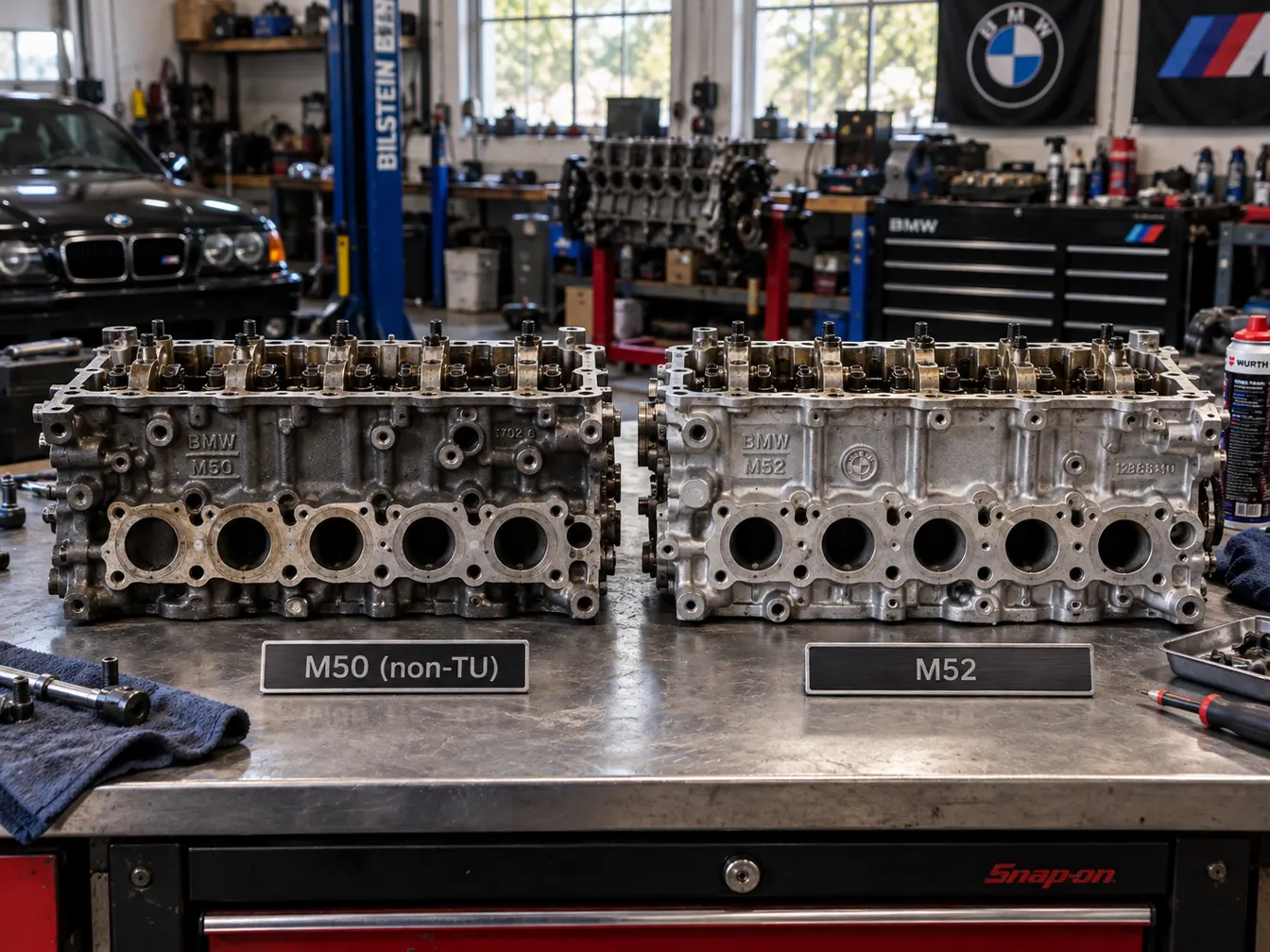
M50 non-VANOS: the original
Built 1990–1992 (E34 525i and the earliest E36 325i). In E36s, Bentley dates the change to VANOS engines to cars built after August 1992.
- No VANOS to maintain or reseal, and simpler timing work.
- Bosch DME M3.1, which has no knock sensors: Bentley lists the 1992 M50 as the only engine in the E36 range without them.
- Internals: engine builders note double valve springs, 7 mm valve stems and 135 mm connecting rods. That’s why the non-VANOS head and rods are popular for high-rpm and boosted builds. The other side of it: no knock control.
- The trade-off: peak torque comes later (245 Nm at 4,700 rpm) and the engine feels softer in everyday driving.
M50TU: VANOS arrives
Built 1992–1996. A VANOS unit on the front of the cylinder head varies the intake camshaft timing, by up to 12.5° (Bentley), giving 250 Nm at 4,200 rpm.
- Bosch DME M3.3.1 with two knock sensors and a Hall-effect camshaft sensor.
- Internals change: single valve springs, 6 mm valve stems and 140 mm rods, so head and valvetrain parts are not interchangeable with the non-VANOS engine.
- The VANOS piston seals age and need resealing: see the M50TU VANOS guide.
M52: the aluminium generation
Built 1995–2000, in the E36 323i/328i from 1996 (OBD2).
- Block: aluminium in most markets. The early Nikasil bores wore prematurely on high-sulphur fuel; iron sleeves followed from 1998. Original US and Canadian cars kept a cast-iron block (except the Z3).
- Siemens MS41.1 with OBD2, and single VANOS.
- M52B28: 193 PS and 280 Nm, at 3,950 rpm. The most torque of the three for a naturally aspirated road car.
- Buying in Europe: know which bore surface the block has. Compression and leak-down tests tell you its condition. See the M52 rebuild guide.
The later M52TU (1998 on) has double VANOS and different electronics: a different engine for swap purposes. See the double VANOS guide.
Which one for which build?
| Goal | Engine | Why |
|---|---|---|
| Simplest swap into an OBD1 car | M50 non-VANOS | No VANOS; OBD1 like the car |
| Best everyday response on OBD1 | M50TU | VANOS torque; knock control |
| Most NA torque, OBD2 car | M52B28 | 2.8 litres, 280 Nm |
| High-rpm or boosted build | M50 non-VANOS internals are popular | Double springs, 7 mm stems, but no knock sensors: plan the engine management accordingly |
Identifying an engine
- Front of the cylinder head: a VANOS unit at the front means M50TU or M52; no VANOS unit means the non-VANOS M50.
- Block: a magnet sticks firmly to cast iron, not to aluminium. An aluminium block means a non-US M52.
- DME label: Bosch M3.1 = non-VANOS M50; Bosch M3.3.1 = M50TU (or US S50); Siemens MS41.1 = M52.
- Engine code stamped on the block confirms it.
This guide is part of the Projekt 36 M50 Engine series. Our build uses the M50B25 Non-VANOS in an E36 316i sedan swap.
→ Related: M43 to M50 parts list | M50 torque specifications | Cooling system overhaul