TL;DR
The M50 is a durable engine; what lets it down on a 30-year-old car is the ageing around it. In rough order of how often it bites:
- the cooling system, mostly plastic parts and old hoses;
- oil leaks from hardened gaskets and seals;
- timing chain tensioners and guides;
- on VANOS engines, the VANOS piston seals;
- idle control and air flow problems.
The head gasket rarely fails on its own; it fails after overheating. Prevent the first problem and you prevent the worst one.
1. Cooling system
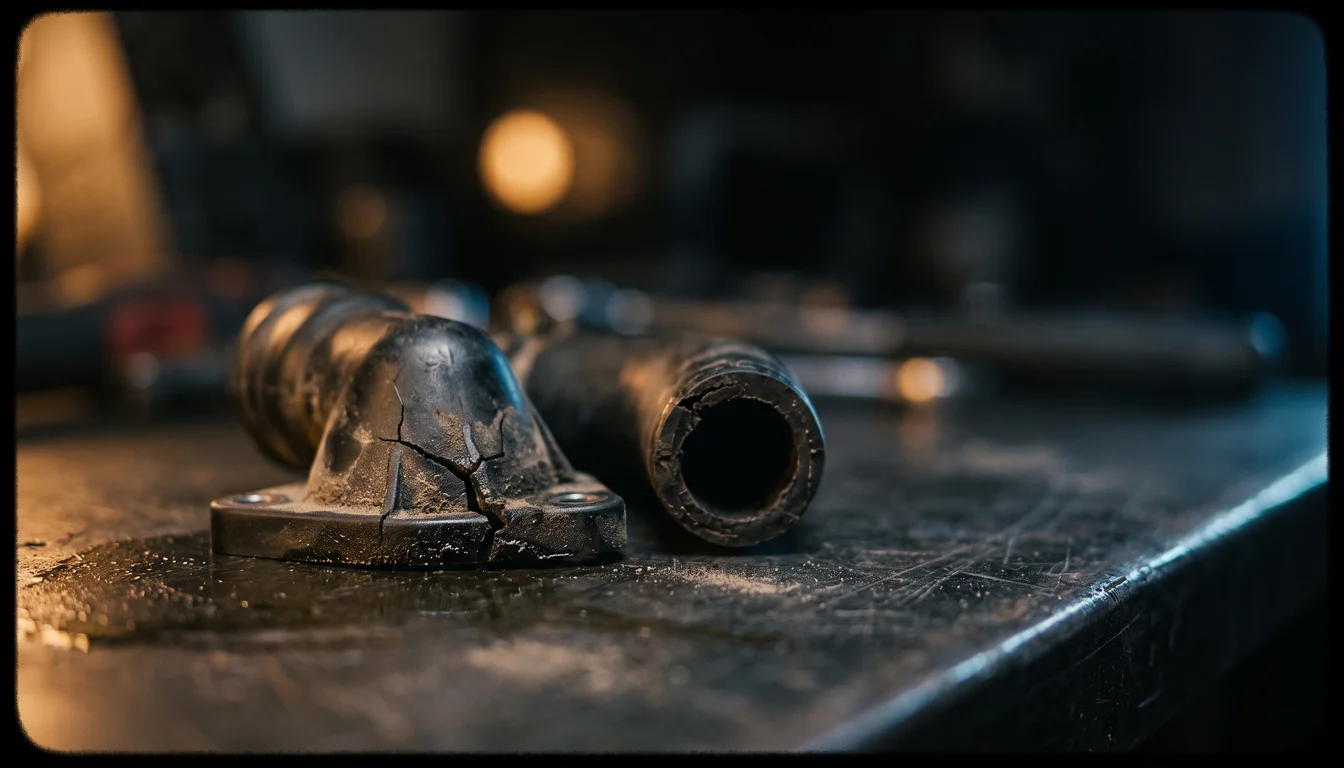
What fails: the plastic expansion tank and radiator tanks crack, the thermostat sticks, hoses perish. Old water pumps with plastic impellers are a known weak point. Bentley recommends replacing the cooling hoses every four years as a preventive measure.
Symptoms: the temperature gauge reading higher than usual, coolant smell, residue on the tank seams, a falling coolant level, or steam (by then the damage may be done).
Prevention: replace the water pump (metal impeller), thermostat, expansion tank and cap, hoses and clamps, and the radiator if it’s old. Pressure-test the system: it should hold within 0.1 bar for two minutes. Full details: cooling system overhaul.
2. Oil leaks
What fails: after decades of heat, gaskets and seals harden and shrink. The usual spots:
- cylinder head cover gasket: oil onto the hot exhaust side means smoke and smell
- oil filter housing gasket
- oil pan gasket
- front crankshaft seal in the lower timing cover
- rear main seal: oil here can contaminate the clutch
- camshaft sensor O-ring (VANOS engines): Bentley calls for a new O-ring whenever the sensor is removed
- VANOS oil line (VANOS engines): new sealing washers whenever it’s undone
Prevention: with the engine out, reseal it completely. In the car, start with the cylinder head cover and oil filter housing gaskets.
3. Timing chains, guides and tensioners
The six-cylinder uses two chains (primary and secondary), each with a hydraulic tensioner. Bentley: a worn chain and sprockets cause noise and erratic valve timing, and a faulty tensioner can also cause chain noise.
Symptoms: rattle from the front of the engine, especially at start-up; persistent rattle when warm; pieces of plastic guide in the oil pan.
Prevention: inspect during any major work, and replace the tensioners and guides if in doubt. Chain removal on the six-cylinder means taking the oil pan off and using the BMW locking tools. See the timing chain guide.
4. VANOS seals (M50TU only)
This doesn’t apply to the non-VANOS M50 (built up to 8/1992).
What fails: the VANOS piston’s O-ring hardens and the piston can’t hold oil pressure, so the intake camshaft doesn’t advance fully.
Symptoms: flat response at lower revs, rough idle, a stored VANOS fault.
Fix: reseal the unit with an aftermarket kit. See the M50TU VANOS guide for the BMW test, which needs at least 8.5 mm of travel, and the repair.
5. Head gasket: a consequence, not a cause
Head gaskets on these engines usually fail after an overheating event. Signs: white exhaust smoke that doesn’t clear, coolant loss with no visible leak, milky residue under the oil cap, combustion gas in the coolant. Confirm with a block (combustion leak) tester and a compression test. Repair: head gasket guide.
6. Idle control valve
What fails: deposits make the valve stick or respond slowly; its coils can also fail.
Symptoms: hunting or unstable idle, stalling when coming to a stop, idle too high.
Checks (Bentley): with the engine running the valve should buzz; switching on the A/C or selecting Drive should keep the idle steady or raise it slightly. Coil resistance on the M50: 20 ± 5 Ω across terminals 1–2 and 2–3, 40 ± 5 Ω across 1–3. These electrical checks don’t prove the valve moves freely: a known-good substitute is the surest test. After a new valve, the idle may be poor for about 10 minutes of driving while the DME adapts.
7. Air flow meter
What fails: the sensing element gets contaminated or fails; the meter can’t be adjusted or repaired. If it fails completely, the DME switches to limp-home mode.
Symptoms: hesitation, poor running, mixture faults.
Checks: on the 1992 M50’s hot-wire meter, the wire should glow about four seconds after a 2,500 rpm shutdown (the burn-off). Rule out air leaks after the meter before blaming it. See the sensor values guide.
Before installation (engine out, e.g. a swap)
- full reseal: all gaskets and seals
- complete cooling system
- timing chains, guides and tensioners inspected, and replaced if in doubt
- spark plugs (tightened to 23–25 Nm)
- idle control valve checked
- drive belt and tensioner
- clutch and flywheel if their history is unknown
No valve adjustment needed: the M50 has hydraulic lifters, non-VANOS and VANOS alike.
Maintenance after installation
Follow BMW’s service schedule for your car as a minimum. On an old engine of unknown history, shorter oil change intervals and a coolant change every two years are cheap insurance.
This guide is part of the Projekt 36 M50 Engine series. Our M50B25 NV is getting a complete reseal and preventive replacement of all wear items before installation.
→ Related: M50 vs M50TU vs M52 Comparison | Cooling System Overhaul | M50 Torque Specifications